背景 某些穿透型子弹弹道较粗,如果索敌模式选择最近的敌人,就会“耿直”地以最近的敌人为目标发射子弹,导致索敌看起来很呆,只命中很少的敌人。其实很多时候,目标周围有很多敌人,由于弹道较粗,只要稍微调整下发射角度就可以命中一堆敌人。
问题定义 穿透型宽弹道的子弹,可以看作一个矩形弹道,子弹起点 start (取 XZ 平面的二维坐标),初始方向 dir ,子弹射程 length ,子弹半宽 halfWidth ,给定主目标 targetEntity ,在保证主目标包含在这个矩形区域内,调整弹道角度,期望以覆盖更多敌人。
一开始会想针目标计算左右边界角度 [targetMinAngle, targetMaxAngle] ,然后以子弹起点为圆心,射程为半径进行怪物查询,查询后对每个目标依次求得 [monsterMinAngle, monsterMaxAngle] 边界,最后求得最大重叠区域的角度。但是这其中的关键点是角度,处理过程中会频繁进行角度、三角函数、反三角函数的转换,这在定点数游戏里一方面性能开销较大,另一方面多次转换后误差也会叠加。
问题转换 首先为了简单起见,其他怪物的度量区间是以主目标方向为主的相对度量区间。考虑到对局中子弹只会向前发射,发射角度是半平面,也就是180°。希望在这个限制条件下,用三角函数的某个中间表达来表征角度区间,需要它能够和角度正相关,同时可以和正余弦方便进行转换。 tan(θ) 看起来是一个比较理想的表达,它在 [-π/2, π/2] 是单调递增的函数。但是在这个区间,它是无界函数,如果用它来表征区间,那么数值会极端发散,不利于后处理。那如果是 tan(θ/2) 呢?在给定的定义域情况下,它的值域是 [-1, 1] ,看起来非常的理想,此外我们还可以用半角公式方便地和 sin(θ) 、 cos(θ) 进行转换:
$$
$$
$$
因此,本问题的解决思路里最重要的一点是,将怪物形成的角度区间,改为基于主目标方向相对角度的 tan(θ/2) 区间 。下文中所述的“区间”中的“值”,皆指代以主目标为基准的相对角度 θ 的半角正切 tan(θ/2)
实现 主目标最终允许偏转的区间
1
2
3
4
5
6
7
8
9
10
11
12
13
14
15
16
public static Fix FindBestParameter (... ){ var targetHalFixarameter = GetHalfAngleParameter(targetDistance, halfWidth); var targetMin = -targetHalFixarameter; var targetMax = targetHalFixarameter; } private static Fix GetHalfAngleParameter (Fix distance, Fix halfWidth ){ if (distance <= halfWidth) return Fix.One; var adjacent = FixMath.Sqrt(distance * distance - halfWidth * halfWidth); return halfWidth / (distance + adjacent); }
扫描候选区怪物
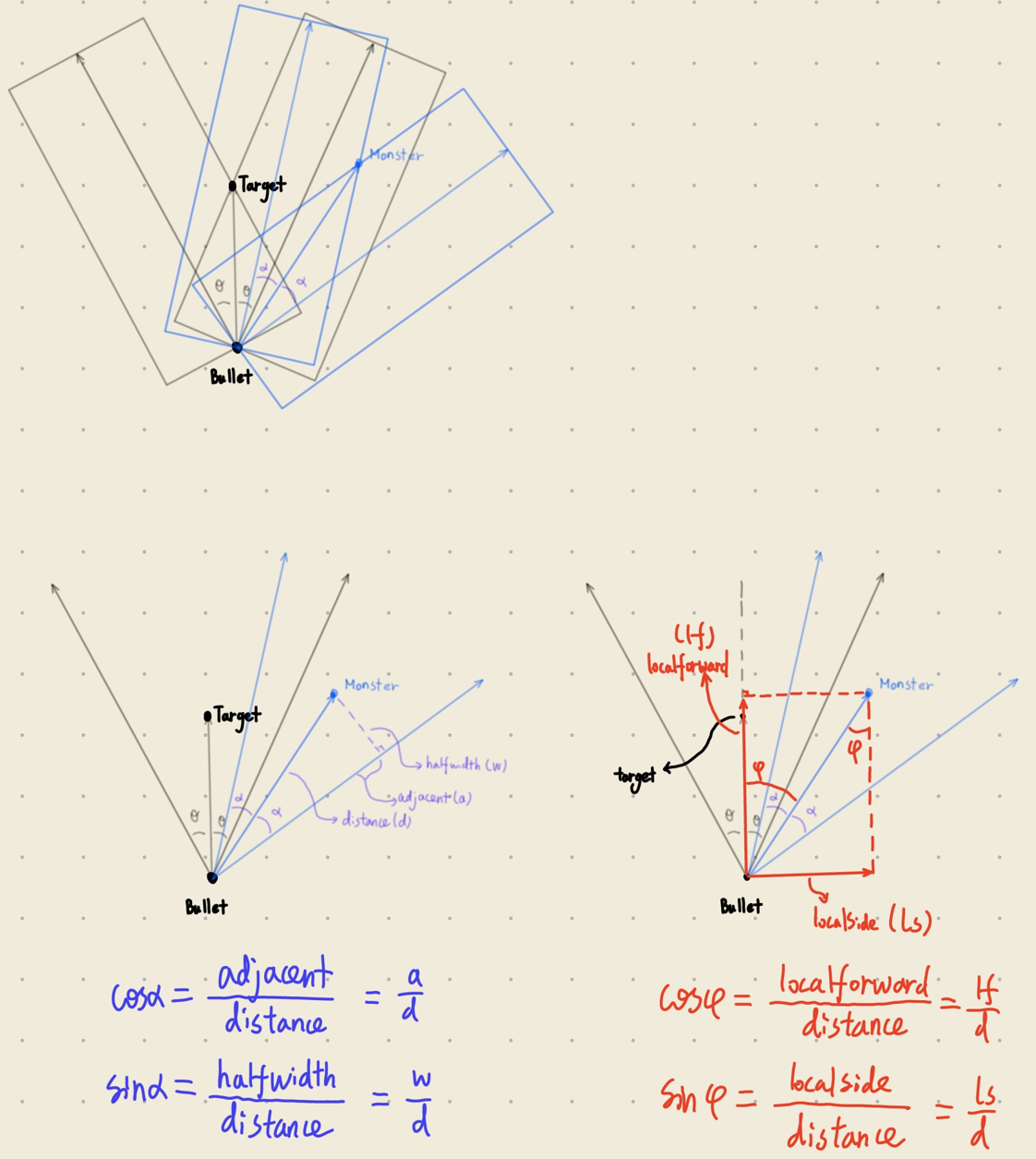
代码中先构建垂直三角形,其中有效半宽取弹道半宽和与怪物距离的最小值,意味着距离小于半宽的敌人,其所产生区间是整个半平面。
随后通过点积求得主目标方向的投影距离,而叉积则求得与主目标方向垂直的投影距离,注意叉积顺序,这里怪物在主目标方向左侧时,叉积结果是正的,反之为负。需要再次强调,这里求得的 localForward 和 localSide 可以理解为,在主目标所张成的坐标系 (F, L) 里的坐标,其中 F 代表主目标方向, L 代表主目标向左旋转 90° 的方向。之所以是向左因为我们叉积顺序是 Cross(F, offset) offset 在主目标方向左侧为正。
上图中下排的左侧是计算瞄准怪物时,最大偏转区间所形成的三角函数;下排右侧是计算怪物方向与主目标方向夹角所形成的三角函数。
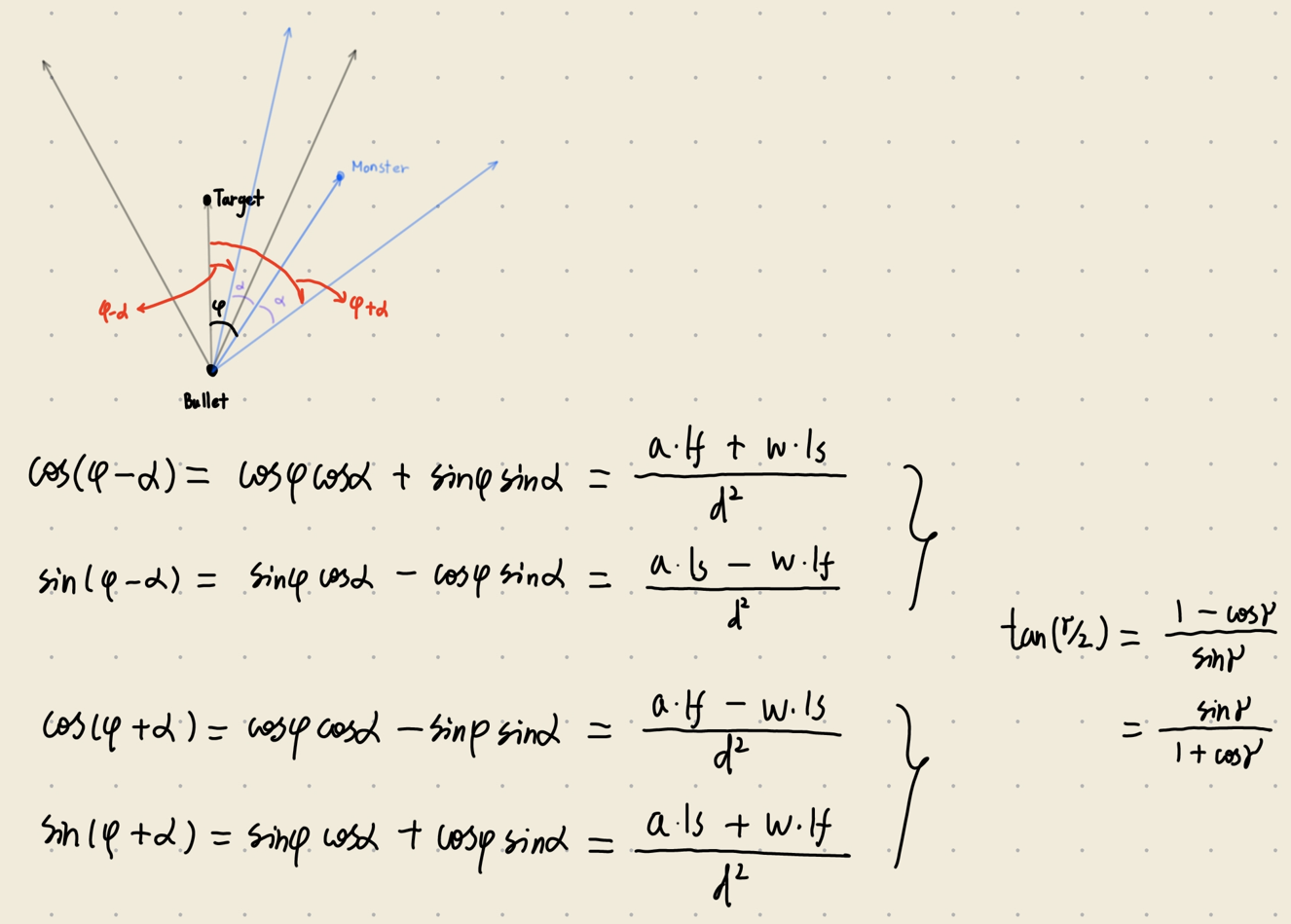
随后通过三角函数和差角公式,将怪物区间偏移转换到主目标方向的局部坐标里,公式解释如上图。再通过 AddBoundaryParameter 调用半角公式求得对应角度的半角正切值。
1
2
3
4
5
6
7
8
9
10
11
12
13
14
15
16
17
18
19
20
21
22
23
24
25
26
27
28
29
30
31
32
33
34
35
36
37
38
39
40
41
42
43
44
45
46
47
48
49
50
51
52
53
54
55
56
57
58
59
60
61
62
63
64
65
66
67
68
69
70
71
72
73
74
75
76
77
78
79
80
81
82
83
84
85
86
87
88
89
90
91
92
93
94
private static void AddCandidateIntervals (... ){ if (distanceSqr <= Fix.Zero) { AddInterval(targetMin, targetMax); return ; } var distance = FixMath.Sqrt(distanceSqr); var effectiveWidth = FixMath.Min(halfWidth, distance); var adjacent = FixMath.Sqrt(FixMath.Max(distanceSqr - effectiveWidth * effectiveWidth, Fix.Zero)); var localForward = Fix2.Dot(baseDirection, offset); var localSide = Fix2.Cross(baseDirection, offset); var inverseDistanceSqr = Fix.One / distanceSqr; Span<Fix> points = stackalloc Fix[4 ]; points[0 ] = targetMin; points[1 ] = targetMax; var pointCount = 2 ; var minCos = (localForward * adjacent + localSide * effectiveWidth) * inverseDistanceSqr; var minSin = (localSide * adjacent - localForward * effectiveWidth) * inverseDistanceSqr; pointCount = AddBoundaryParameter(points, pointCount, minCos, minSin, targetMin, targetMax); var maxCos = (localForward * adjacent - localSide * effectiveWidth) * inverseDistanceSqr; var maxSin = (localSide * adjacent + localForward * effectiveWidth) * inverseDistanceSqr; pointCount = AddBoundaryParameter(points, pointCount, maxCos, maxSin, targetMin, targetMax); SortAndCompact(points, ref pointCount); Span<bool > segmentHits = stackalloc bool [3 ]; for (var i = 0 ; i + 1 < pointCount; i++) { var midpoint = (points[i] + points[i + 1 ]) * Fix.Half; segmentHits[i] = ContainsAtParameter(localForward, localSide, midpoint, halfWidth); } var inRun = false ; var runStart = Fix.Zero; for (var i = 0 ; i + 1 < pointCount; i++) { if (segmentHits[i]) { if (!inRun) { inRun = true ; runStart = points[i]; } } else if (inRun) { AddInterval(runStart, points[i]); inRun = false ; } } if (inRun) AddInterval(runStart, points[pointCount - 1 ]); } private static int AddBoundaryParameter (Span<Fix> points, int count, Fix cosine, Fix sine, Fix targetMin, Fix targetMax ){ if (cosine < Fix.Zero) return count; var parameter = sine / (Fix.One + cosine); if (parameter >= targetMin && parameter <= targetMax) points[count++] = parameter; return count; } private static bool ContainsAtParameter (Fix localForward, Fix localSide, Fix parameter, Fix halfWidth ){ var parameterSqr = parameter * parameter; var oneMinusParameterSqr = Fix.One - parameterSqr; var twiceParameter = 2 * parameter; var denominator = Fix.One + parameterSqr; var forwardNumerator = localForward * oneMinusParameterSqr + localSide * twiceParameter; var sideNumerator = FixMath.Abs(localSide * oneMinusParameterSqr - localForward * twiceParameter); return forwardNumerator >= Fix.Zero && sideNumerator <= halfWidth * denominator; }
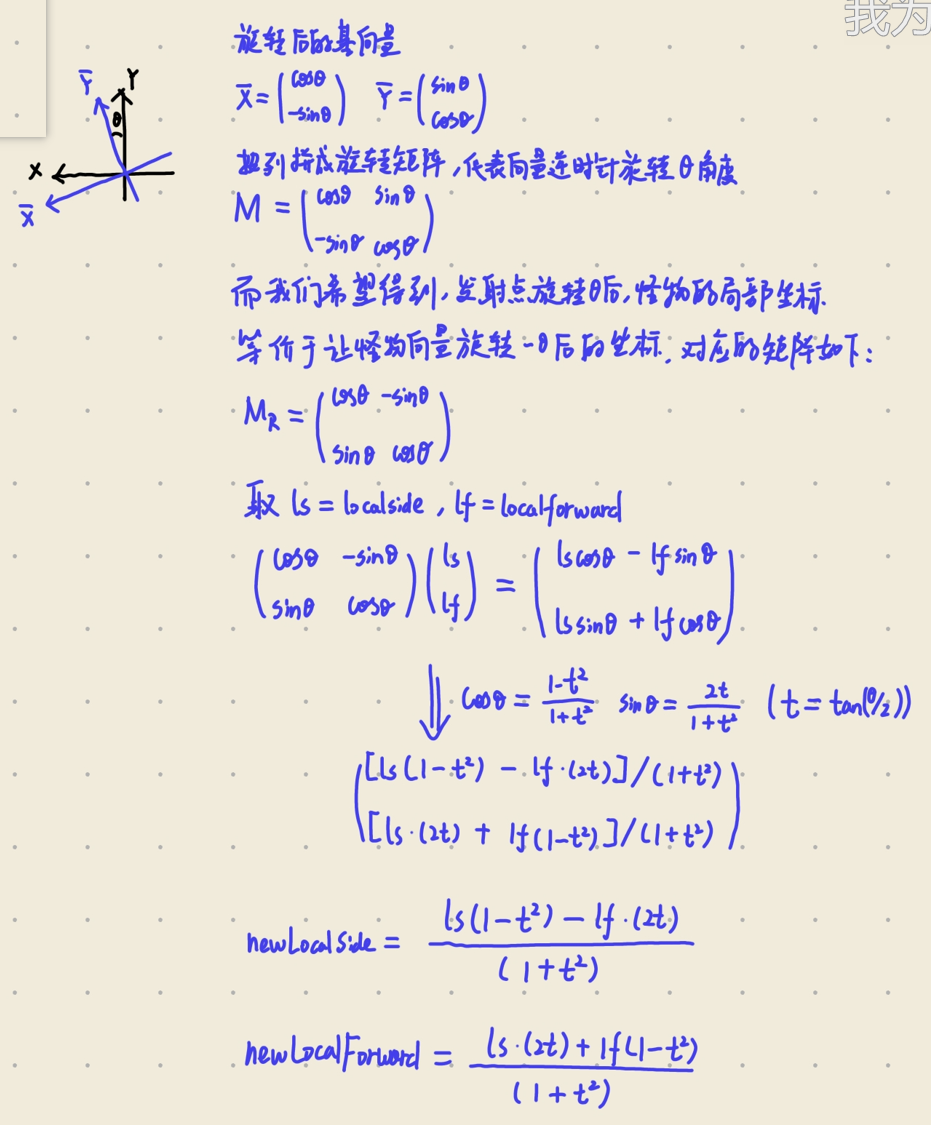
上方代码中 ContainsAtParameter 是判断“使用某个半角参数 parameter 对应的方向发射时,当前怪物中心是否位于矩形弹道内。”,本质是向量二维旋转,但是由于坐标轴里X是左为正,所以和标准旋转矩阵还是有些差异的,可以从不同角度来理解这个过程。下图给出五种不同的理解角度:
上图的推导殊途同归,总结起来有如下两个视角:
这叫被动坐标变换:向量没变,观察它的坐标系变了
这叫主动向量变化:坐标系没变,向量变了。两者是对同一问题的不同观察。
在得到用正弦余弦的转换关系后,再用正切的半角公式,将 tan(θ/2) 带入进去,就会得到代码里的形式了,此处不再赘述。
扫线求最优偏转 取区间中点作为稳定代表。
1
2
3
4
5
6
7
8
9
10
11
12
13
14
15
16
17
18
19
20
21
22
23
24
25
26
27
28
29
30
31
32
33
34
35
36
37
38
39
40
41
42
43
private static Fix ScanBestParameter (){ var activeCount = 0 ; var bestCount = -1 ; var bestParameter = Fix.Zero; for (var i = 0 ; i < _eventCache.Count;) { var parameter = _eventCache[i].Parameter; var starts = 0 ; var ends = 0 ; do { if (_eventCache[i].Delta > 0 ) starts++; else if (_eventCache[i].Delta < 0 ) ends++; i++; } while (i < _eventCache.Count && _eventCache[i].Parameter == parameter); activeCount += starts; if (parameter == Fix.Zero && IsBetter(activeCount, parameter, bestCount, bestParameter)) { bestCount = activeCount; bestParameter = parameter; } activeCount -= ends; if (i < _eventCache.Count && parameter < _eventCache[i].Parameter) { var interiorParameter = (parameter + _eventCache[i].Parameter) * Fix.Half; if (IsBetter(...)) { bestCount = activeCount; bestParameter = interiorParameter; } } } return bestParameter; }
还原最优命中偏转角 最后利用求得的 parameter 也就是半角正切值还原到正余弦,然后再利用标准的二维旋转矩阵,求得最终的发射方向。
1
2
3
4
5
6
7
8
9
private static Fix2 DirectionFromParameter (... ){ var parameterSqr = parameter * parameter; var inverse = Fix.One / (Fix.One + parameterSqr); var cosine = (Fix.One - parameterSqr) * inverse; var sine = 2 * parameter * inverse; return new Fix2(baseDirection.x * cosine - baseDirection.y * sine, baseDirection.x * sine + baseDirection.y * cosine).normalized; }
拓展 sin(θ) 前面说到,度量选择 tan(θ) 一方面是它作为中间表达,在定义域里是递增的,且在计算过程中不需要和真实角度打交道。其实在这个定义域里 sin(θ) 也是完全满足的。之所以不采用它,是因为在计算过程中,它需要开平方求 cos(θ),对性能有一定影响。
1 2 3 4 5 6 7 8 9 10 11 12 13 14 15 16 17 18 19 20 21 22 23 24 25 26 27 28 29 30 31 32 33 34 35 36 37 38 39 40 41 42 43 44 45 46 47 48 49 50 private static FP GetHalfAngleParameter (FP distance, FP halfWidth ){ if (distance <= halfWidth) return FP.One; return halfWidth / distance; } private static int AddBoundaryParameter (Span<FP> points, int count, FP cosine, FP sine, FP targetMin, FP targetMax ){ if (cosine < FP.Zero) return count; if (sine >= targetMin && sine <= targetMax) points[count++] = sine; return count; } private static bool ContainsAtParameter (FP localForward, FP localSide, FP sine, FP halfWidth ){ var cosine = TSMath.Sqrt(TSMath.Max(FP.One - sine * sine, FP.Zero)); var forward = localForward * cosine + localSide * sine; var side = TSMath.Abs(localSide * cosine - localForward * sine); return forward >= FP.Zero && side <= halfWidth; } private static TSVector2 DirectionFromParameter (TSVector2 baseDirection, FP sine ){ var cosine = TSMath.Sqrt(TSMath.Max(FP.One - sine * sine, FP.Zero)); return new TSVector2(baseDirection.x * cosine - baseDirection.y * sine, baseDirection.x * sine + baseDirection.y * cosine).normalized; }
改为右侧为正 调整下求 localSide 的叉积顺序,可以变为右侧为正,将右侧改为第一个轴,就完全等同于标准二维坐标系了,以 (R, F) 为坐标系的情况下 ContainsAtParameter 里可以直接用标准二位旋转矩阵。(再次赘述:前面左侧为正的时候,也可以 (F, L) 坐标系下直接用标准二维旋转矩阵)
1
2
3
4
5
6
7
8
9
10
11
12
13
14
15
16
17
18
19
20
21
22
23
24
25
26
27
28
29
30
31
32
33
34
35
36
37
38
39
40
41
42
43
44
45
46
47
48
49
50
51
52
53
54
55
56
57
58
59
60
61
62
63
64
65
66
67
68
69
70
71
72
73
74
75
76
77
78
79
80
81
82
83
84
85
86
87
88
89
90
91
92
93
94
95
96
97
private static void AddCandidateIntervals (TSVector2 baseDirection, TSVector2 offset, FP distanceSqr, FP halfWidth, FP targetMin, FP targetMax ){ if (distanceSqr <= FP.Zero) { AddInterval(targetMin, targetMax); return ; } var distance = TSMath.Sqrt(distanceSqr); var effectiveWidth = TSMath.Min(halfWidth, distance); var adjacent = TSMath.Sqrt(TSMath.Max(distanceSqr - effectiveWidth * effectiveWidth, FP.Zero)); var localForward = TSVector2.Dot(baseDirection, offset); var localRight = TSVector2.Cross(offset, baseDirection); var inverseDistanceSqr = FP.One / distanceSqr; Span<FP> points = stackalloc FP[4 ]; points[0 ] = targetMin; points[1 ] = targetMax; var pointCount = 2 ; var minCos = (localForward * adjacent - localRight * effectiveWidth) * inverseDistanceSqr; var minSin = (-localRight * adjacent - localForward * effectiveWidth) * inverseDistanceSqr; pointCount = AddBoundaryParameter(points, pointCount, minCos, minSin, targetMin, targetMax); var maxCos = (localForward * adjacent + localRight * effectiveWidth) * inverseDistanceSqr; var maxSin = (-localRight * adjacent + localForward * effectiveWidth) * inverseDistanceSqr; pointCount = AddBoundaryParameter(points, pointCount, maxCos, maxSin, targetMin, targetMax); SortAndCompact(points, ref pointCount); Span<bool > segmentHits = stackalloc bool [3 ]; for (var i = 0 ; i + 1 < pointCount; i++) { var midpoint = (points[i] + points[i + 1 ]) * FP.Half; segmentHits[i] = ContainsAtParameter(localForward, localRight, midpoint, halfWidth); } var inRun = false ; var runStart = FP.Zero; for (var i = 0 ; i + 1 < pointCount; i++) { if (segmentHits[i]) { if (!inRun) { inRun = true ; runStart = points[i]; } } else if (inRun) { AddInterval(runStart, points[i]); inRun = false ; } } if (inRun) AddInterval(runStart, points[pointCount - 1 ]); } private static bool ContainsAtParameter (FP localForward, FP localRight, FP parameter, FP halfWidth ){ var parameterSqr = parameter * parameter; var oneMinusParameterSqr = FP.One - parameterSqr; var twiceParameter = 2 * parameter; var denominator = FP.One + parameterSqr; var forwardNumerator = localForward * oneMinusParameterSqr - localRight * twiceParameter; var rightNumerator = TSMath.Abs(localRight * oneMinusParameterSqr + localForward * twiceParameter); return forwardNumerator >= FP.Zero && rightNumerator <= halfWidth * denominator; }
之前采用的左侧为正,所以 localSide > 0 代表左侧,怪物偏转角 φ > 0 也是逆时针的,向左 两者方向一致,所以:
1
2
cosφ = localForward / distance sinφ = localSide / distance
而现在改为右侧为正,两者就是反向的,所以:
1
2
cosφ = localForward / distance sinφ = -localSide / distance
所以上面的和差角公式里符号有些差异。